
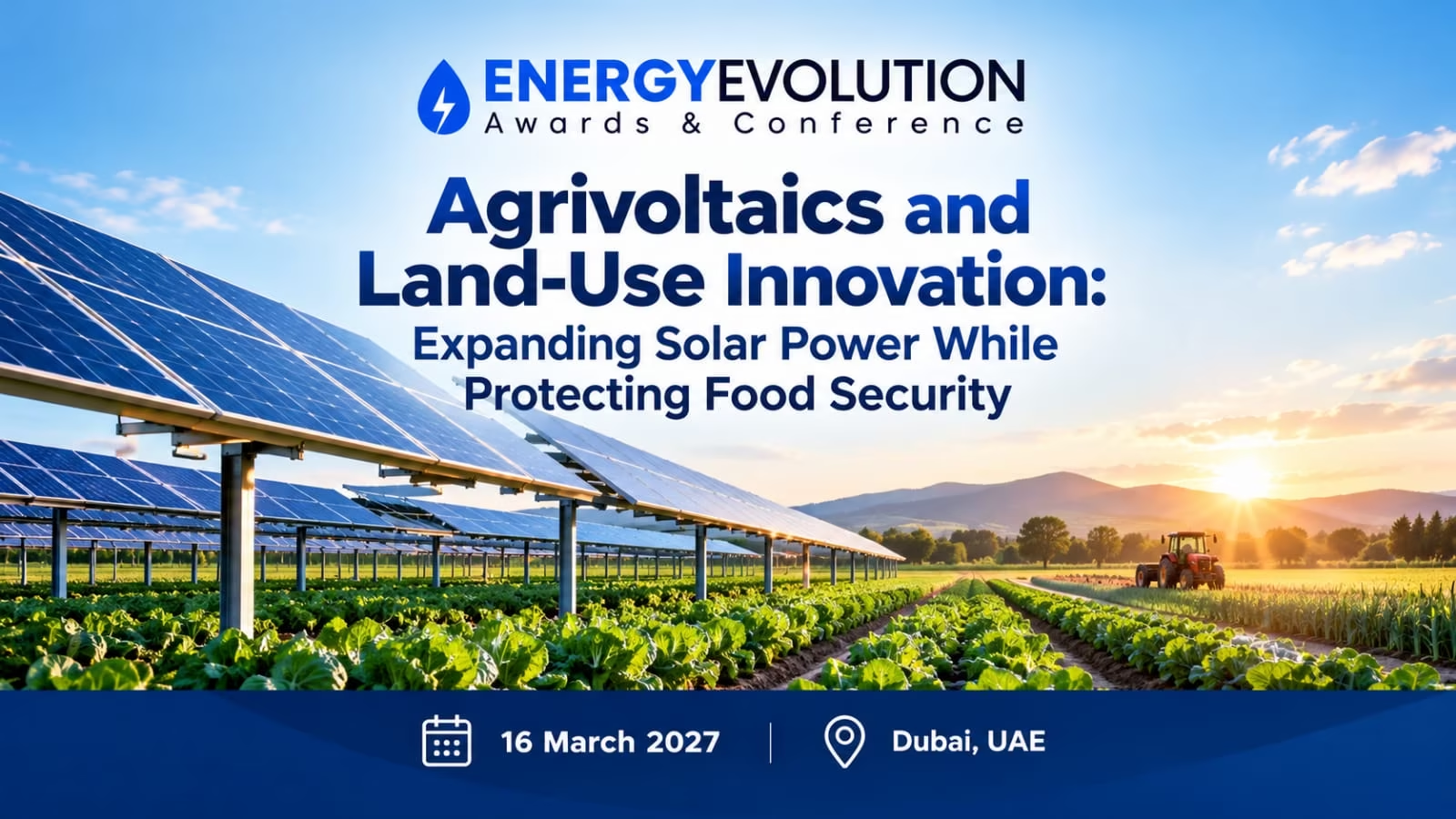
As solar deployment accelerates worldwide, land availability has become an increasingly important challenge for the energy transition. Agrivoltaics offers a practical approach by combining solar power generation with agricultural production on the same land. With appropriate system design, projects can generate renewable electricity while allowing crops to grow or livestock to graze.
For the energy sector, agrivoltaics represents more than an agricultural innovation. It offers a way to improve land-use efficiency, address competing demands for land, strengthen relationships with farming communities, and support more resilient renewable energy development.
Solar Expansion Meets the Land Challenge
Utility-scale solar projects require substantial land, which can create competition with farming, grazing, biodiversity, and rural livelihoods. These competing demands can complicate project planning and affect community acceptance.
Agrivoltaics, also known as agricultural photovoltaics or AgriPV, integrates solar panels with agricultural activities. Depending on the application, panels may be elevated or spaced to provide sufficient room for cultivation, livestock movement, and farm operations.
The International Energy Agency’s Photovoltaic Power Systems Programme (IEA PVPS) identifies dual land use as an important opportunity for improving how solar installations are planned and operated. Its 2025 report examines system performance, modelling, technical challenges, and the policy frameworks needed to support wider adoption.
The opportunity is significant, but successful implementation depends on more than installing panels above farmland. Developers must consider agricultural requirements, solar output, site conditions, maintenance, and the long-term economics of both activities.
Protecting Crop Productivity Through Smarter Design
A central consideration is whether solar panels affect agricultural yields. The outcome depends on crop selection, panel height and spacing, shading patterns, local climate, soil conditions, and irrigation practices.
For suitable crops, partial shading can reduce heat stress and slow moisture loss. However, excessive shade can limit photosynthesis and reduce yields for crops that require high levels of sunlight. Agrivoltaic systems therefore need to be designed around the needs of both electricity generation and agricultural production.
In its July 2026 policy brief, The Energy and Resources Institute (TERI) reported evidence of yield improvements of 10–20% for certain crops and water savings of around 30% in agrivoltaic applications. These results highlight the potential benefits while underscoring the importance of crop and site suitability.
Research also points to opportunities at a smaller scale. A 2025 study published by the International Institute for Sustainable Development (IISD) examined 162 farmers using solar-powered irrigation in Bihar, India. Of these, 70 reported growing crops beneath solar panels. Among the farmers practising this form of micro-agrivoltaics, 40% reported yields more than 20% higher, 35% reported marginally higher yields, and 25% reported no change.
These findings highlight the potential of micro-agrivoltaics to support agricultural productivity while integrating solar power generation into farming systems.
Projects Demonstrating the Potential of Dual-Use Solar
Agrivoltaics is attracting interest across different markets, with projects exploring how solar infrastructure can coexist with productive land use.
In Maharashtra, India, the Parbhani agrivoltaic installation demonstrates an approach based on elevated bifacial panels and agricultural production beneath the solar canopy. The project highlights the importance of panel configuration, available growing space, and crop selection when integrating renewable energy with farming.
In the United Arab Emirates, a significant development was announced in January 2026. Masdar and Elite Agro Holding partnered to develop an agricultural photovoltaic project at Al Foah Farm in Al Ain. The initiative combines solar generation with greenhouse-based crop production and is intended to provide a reference model for AgriPV in the region.
The project is particularly relevant to hot, water-scarce environments, where land availability, irrigation requirements, and food security are important considerations. Its planned assessment of energy performance, crop productivity, and water efficiency could help inform future projects adapted to regional conditions.
Together, these examples illustrate how agrivoltaics can be tailored to different agricultural systems. They also highlight the need to evaluate projects using measurable results rather than assuming that every configuration will deliver the same benefits.
Why Agrivoltaics Matters for the Energy Transition
Agrivoltaics can help energy developers address several challenges associated with expanding renewable power.
More efficient land use: Combining electricity generation with agriculture can reduce the need to dedicate entire sites exclusively to solar production, where compatible designs are feasible.
Stronger community engagement: Continued agricultural activity can help farmers retain productive use of their land and potentially benefit from additional income opportunities. Early consultation and fair commercial arrangements remain essential.
Greater climate resilience: Appropriate shading may reduce heat stress and water loss for selected crops, particularly in hot regions. The benefits depend on local conditions and system design.
New investment and operating models: Developers can explore partnerships with farmers, agricultural businesses, and technology providers.
However, project viability depends on capital costs, maintenance requirements, electricity revenues, agricultural returns, and access to suitable infrastructure.
The IEA PVPS identifies stakeholder engagement, supportive policy frameworks, and transparent performance standards as important factors in agrivoltaic deployment. These considerations will be central to moving from individual demonstrations towards commercially viable projects.
Recognizing Innovation in Dual-Use Solar
Agrivoltaics demonstrates how renewable energy infrastructure can respond to competing land-use priorities while creating opportunities for collaboration between the energy and agricultural sectors. Its long-term contribution will depend on sound engineering, reliable performance data, viable business models, and continued agricultural productivity.
For energy developers, investors, technology providers, and policymakers, the next step is to identify solutions that can be replicated, measured, and adapted to local conditions.
Explore Energy Innovation at Energy Evolution Awards and Conference 2027
Discover the ideas, technologies, and projects shaping the future of energy at the Energy Evolution Awards and Conference 2027. Connect with industry leaders, explore emerging approaches to renewable energy deployment, and recognize innovations advancing a more efficient, resilient, and sustainable energy system.
Register now energyevolutionconference.com